
Salt Lake County Open Records Inventory
Salt Lake County keeps no single master index. Land documents belong to the Recorder, current assessment data to the Assessor, marriage licenses to the Clerk, and county-agency files to the office that made them. Utah Courts run a separate statewide system. Vital certificates are split again between county and state health offices, the Clerk, and the court. The table leads with the record set because that choice determines the custodian, search tool, copy route, and restriction.
| Record set | Keeper | Web coverage | Access route |
|---|---|---|---|
| Deeds, liens, and plats | County Recorder | Public Search and Data Services; first web year not stated | Free current view, paid tools, counter, or phone |
| Assessment and parcel data | County Assessor | Current owner, address, and parcel data | Free search, GIS viewer, or counter |
| Civil, criminal, and probate cases | Utah Courts and court clerk | Public district and justice cases in XChange | Paid web, free terminal, clerk, or archives |
| Birth, death, marriage, and divorce | Health offices, Clerk, or court | Historical indexes vary | Qualified copy request or public archival route |
| Marriage licenses | County Clerk | Exact index years not stated | Mail, phone for a spouse, or certified copy |
| Jail and law-enforcement files | County Sheriff or creating agency | Current dockets and rosters | Free roster or written agency request |
Public status does not make every field visible. Adoption files, juvenile cases, sealed or expunged cases, protected domestic information, recent vital certificates, protected voter data, and driver records can be closed or limited. When one file mixes open and private material, ask for a segregated copy with the protected parts removed.
Salt Lake County Recorder Access
The Recorder Public Search gives a free, informational view of current property data. A user must accept its terms, enter an address or parcel number, and choose a value from the suggested list. The result can identify the owner of record, parcel, site address, legal description, and recorded-document references. It may lag by at least 24 hours, and the office warns that a title search may still be needed. The oldest online index year is not published.
| Search control | Input | Required | How it works |
|---|---|---|---|
| Terms of Service | Agreement action | Yes | Accept before searching |
| Address or Parcel Number | Autocomplete text | Yes | Select a suggested value |
| Search | Button | Yes | Opens the property result |
Recorder Data Services adds owner history, parcel-number history, legal descriptions, recorded documents, the tract index, chain of title, subdivision maps, and plats. Occasional use costs $5 for 24 hours. The Recorder counter and phone remain the fallback for older material, unavailable copies, and questions about restricted images.
Note: Recorder ownership controls title questions; a current assessment entry is a tax snapshot, not proof of a conveyance.
Salt Lake County Property Record Layers
The Salt Lake County Assessor accepts an owner in “Last Name, First Name” form, a suggested address, or a segmented parcel number. Results can include owner, parcel ID, site-address parts, acreage, property type, tax class or district, exemptions, a building-permit flag, and GIS coordinates. The site address is the physical location. A tax mailing address can differ and should not be treated as the owner’s home.
The GIS and Parcel Viewer adds boundaries and tax-district context. The county’s Property Information and Taxes hub also joins the Assessor, Recorder, Auditor, and Treasurer routes. Plats and legal descriptions connect the map back to recorded land. The Assessor receives parcel information from the Recorder, but the two offices serve different roles. A parcel viewer label such as NULL or void can mean the land is not taxed; it does not prove county ownership.
Salt Lake County Court Record Channels
XChange covers public Utah district and justice court cases, including Salt Lake County’s Third District Court and local justice courts. The Utah Courts records page sets out the online, courthouse, and archive routes, while the XChange search guide explains the filters and result fields. Search fields include jurisdiction, case number, last name or company, first name, case type, statewide or local scope, and date ranges. Results may show the court, case type and number, filing date, party role, case events, and available document links. Electronic documents available through the system cost $1 each.
The web service is paid, but most district courthouses and the Utah State Law Library offer free public terminals. That is the practical fallback for finding a case number before asking the clerk for a file, certified copy, or hearing recording. Historical court material, especially cases more than 50 years old, may have moved to the Utah State Archives. Missing web documents do not prove that the clerk lacks the filing.
Note: Juvenile, adoption, sealed, expunged, and protected parts of domestic cases do not become open through a name search.
Salt Lake County Vital Record Limits
Utah Code §26B-8-125(5) opens birth records after 100 years, death records after 50 years, and other vital records after 75 years. Before those points, recent certified records require identification and a qualifying relationship or legal basis. Salt Lake County Health Vital Records and Utah Vital Records issue birth and death certificates plus marriage and divorce abstracts. The County Clerk holds original marriage licenses, while the court holds the underlying divorce case.
Applications can be made online, by mail, or in person as directed by the vital office. The fee schedule effective July 1, 2026 lists $25 for an initial birth certificate, $35 for death, and $25 for a marriage or divorce abstract. A March 2026 birth form still prints $22, so payment instructions should be checked at submission.
Marriage public records use a different copy channel. The Salt Lake County Clerk charges $2 for an uncertified mail copy, $3 for a phone order, and $5 for a certified copy. A mail request identifies both applicants as named on the application, the date and place, and the license number if known. Phone orders are limited to a spouse and require the year, names, callback details, and payment data. A state marriage abstract is not an image of the Clerk’s original license. The Utah certificate ordering page shows the available request routes.
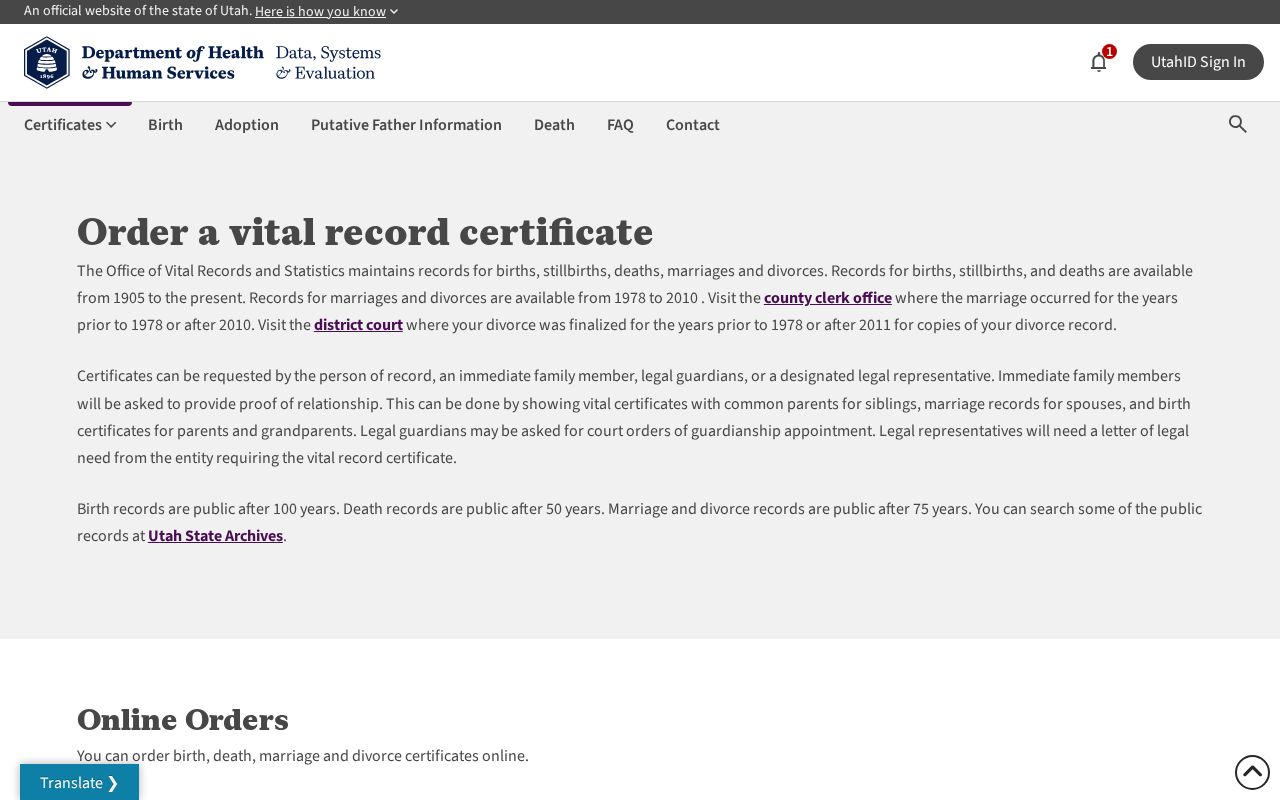
The ordering screen helps separate a recent certified copy from an open historical index, which serves a different purpose.
Salt Lake County Jail Public Records
The Sheriff’s Jail Dockets and Rosters provides current in-and-out dockets and roster views for Metro and Oxbow jails. Booking information changes fast, and a booking is not a conviction. The current privacy notice explains why certain identifiers are removed under Utah government-data provisions and county policy. A person’s Sheriff’s Office number can be found through the prisoner route or by calling the general jail line at 385-468-8400.
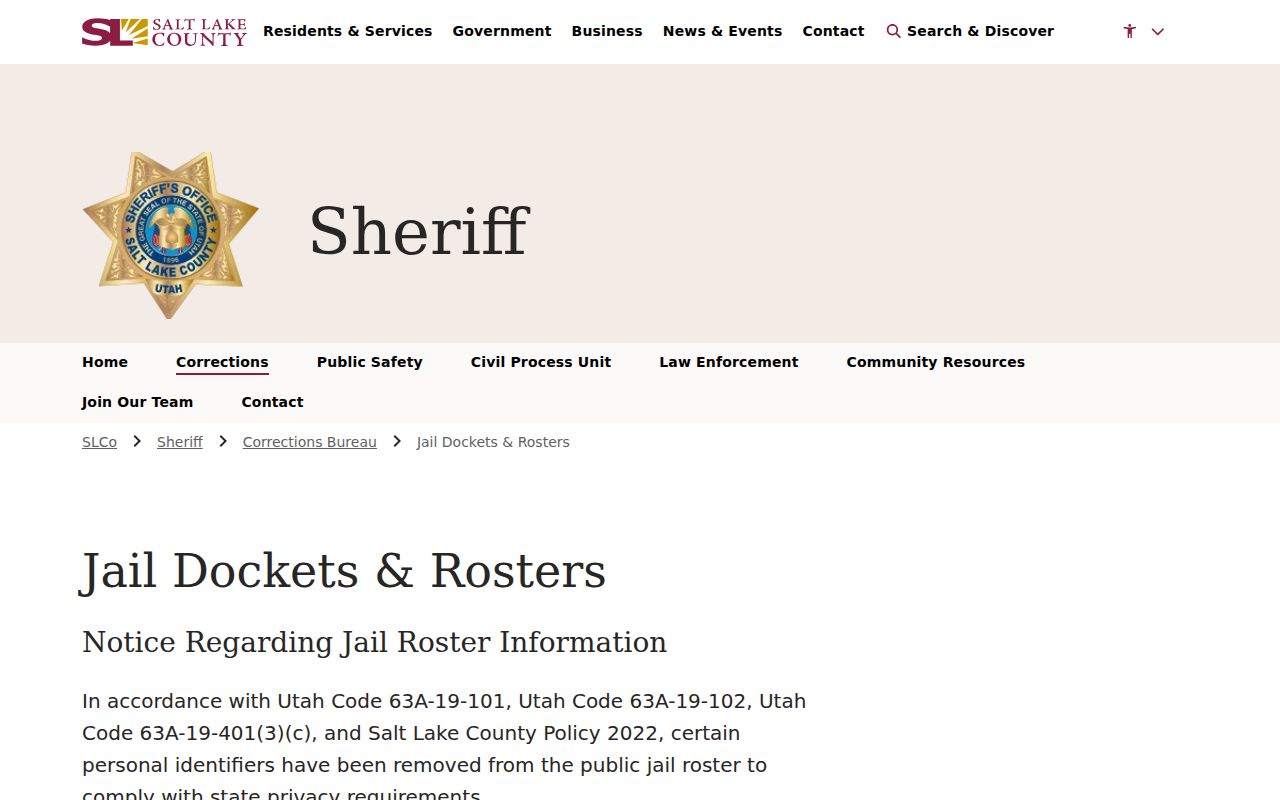
The roster screen is useful for current status, while police reports must be requested from the agency that created them. Give that agency a case number, date, place, and involved party when known. Private identifiers can be removed before release.
Salt Lake County Records Custodians
Several high-use Salt Lake County offices work from the County Government Center at 2001 South State Street in Salt Lake City. A counter visit can resolve an index gap, confirm the right copy type, or reach older material. The Recorder publishes weekday hours of 8 a.m. to 5 p.m. Courts and city agencies remain separate custodians.
Salt Lake County Recorder
2001 S State St., Suite N1-600
Salt Lake City, UT
385-468-8145
Salt Lake County Assessor
2001 S State St.
Salt Lake City, UT
385-468-8000
Current assessment and parcel records
Salt Lake County Clerk
2001 S State St.
Salt Lake City, UT
385-468-7400
Marriage licensing and county elections
City-created records stay with the city that made them. The county request portal cannot replace a Salt Lake City, Sandy, West Jordan, or other municipal request. Likewise, a court record must go through Utah Courts or the creating court clerk.
Older public records have another route. Salt Lake County Archives holds permanent county government series dating from the county’s organization in 1852. Utah State Archives keeps historical court, county, and state-agency series, with many court transfers more than 50 years old. Search or ask by creating agency and record series because some volumes have a separate index or no name index at all. Series-level restrictions still control access after a transfer.
Salt Lake County Records Terms
Portal labels describe different levels of proof. Knowing the distinction can prevent an order for the wrong item.
- Index
- A list of key facts that points to a stored record. It is not always the full document.
- Image
- A scan of the recorded filing or certificate. Access may cost more or require eligibility.
- Certified copy
- A copy authenticated by its custodian for uses that require official proof.
- Custodian
- The office responsible for keeping and releasing the record.
- Segregated copy
- An open copy from which protected portions have been removed.
The index is best for discovery. Ask the keeper for the image or certified copy when the underlying text or official authentication matters.
Salt Lake County GRAMA Costs
Salt Lake County routes agency requests through its GRAMA and NextRequest page. Filing is free, but locating, compiling, copying, and certifying records may create charges. The first 30 minutes of search or compilation are free, followed by $25 per hour. Paper copies cost no more than $0.50 per page, media is billed at actual cost, and certification is $10 unless another law sets the fee. An estimate above $50 may require prepayment.
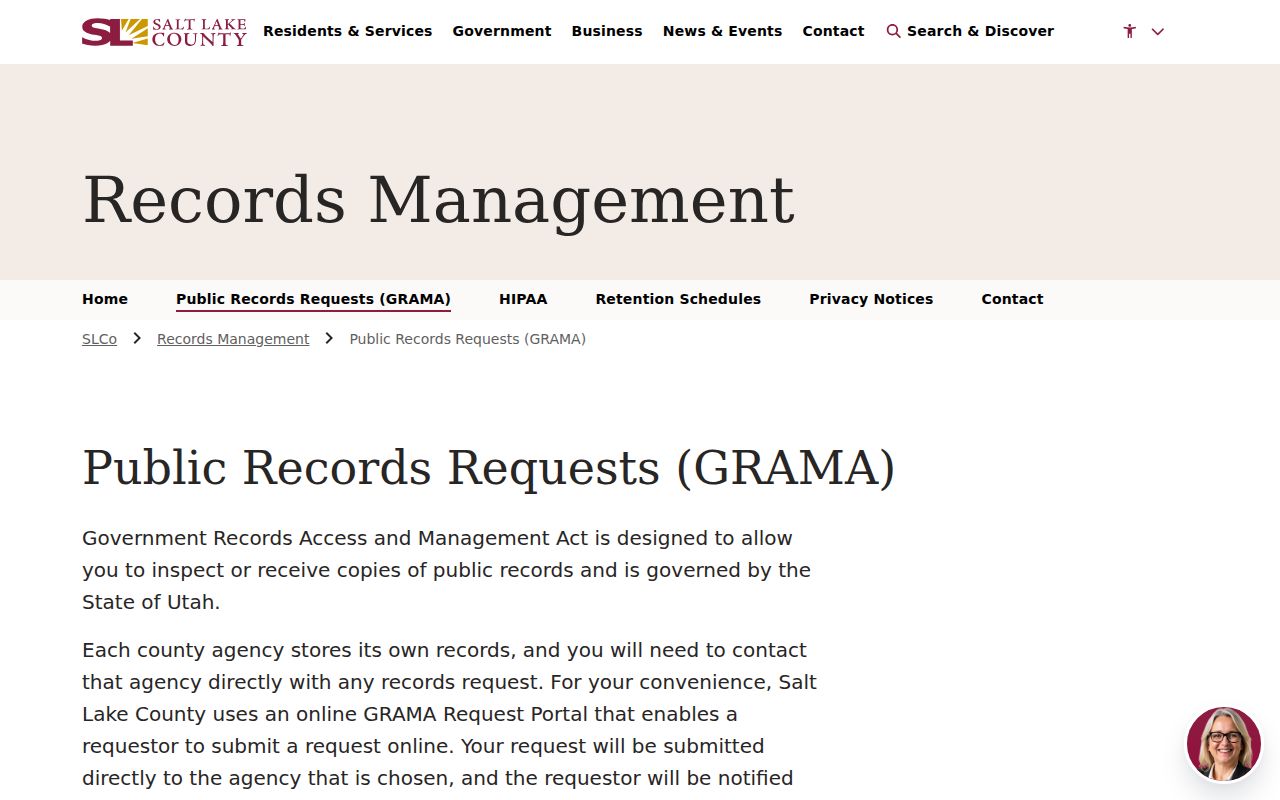
The portal’s response and fee information makes a narrow date range and named record series worth supplying at the start. A requester may seek a public-interest fee waiver and can ask for an estimate before production.
Limits on Salt Lake County Records
GRAMA, Utah Code Title 63G, Chapter 2, creates a right to inspect public government records. It does not cancel a statute that classifies a file as private, controlled, or protected. Recent vital certificates, adoption files, juvenile cases, sealed cases, At-Risk voter records, driver information, health information, and some law-enforcement material remain limited. An agency also need not build a new analysis or answer questions when no existing record contains the answer.
Lawful personal use. Open access does not permit stalking, threats, harassment, or intimidation. Use Salt Lake County records for lawful research and confirm sensitive facts with the custodian.
A written denial should give the classification or legal basis and explain appeal rights. A requester can appeal to the chief administrative officer and then, as GRAMA allows, to the State Records Committee or district court. If only part of the file is protected, ask the agency to segregate the open part.
Request Salt Lake County Public Records
A GRAMA request must describe an existing record with reasonable specificity. Salt Lake County publishes an ordinary response time of ten business days, or five business days for media requests, with notice when volume or another statutory circumstance supports an extension. Keep the tracking messages and make each request narrow enough for the selected agency to identify its records.
- Identify the creating agency. A county, city, court, and state office may each hold different parts of the same event.
- Check the agency index first. Save the parcel, case, document, or report number that will narrow the request.
- Submit requester contact information, the record series, date range, names or identifiers, and the desired format through the proper form, portal, mail, or office channel.
- Choose inspection or copies. Ask for a cost estimate or fee waiver before work begins when those choices matter.
- Review any denial for its legal basis. Narrow the request, seek a segregated copy, or use the stated appeal route.
Note: A portal result helps locate the file, but the responsible custodian supplies the official copy and explains any redaction.
Salt Lake County Record Alerts
Recorder Property Watch is a timely prevention tool. Owners can enroll for notice of new recording activity connected to their property. The alert is not a legal finding of fraud, and it does not replace a title search. An unfamiliar notice should be checked with the Recorder at 385-468-8145 before taking further action.
The service matters because Recorder Public Search can lag while new filings enter the system. A prompt alert can point an owner to the document number and the office that holds the image. Keep the distinction clear: the notice signals activity, while the recorded instrument and the Recorder’s response establish what was filed.